
Biology of Layoff
29 OCTOBER 2026 · 7 MIN READA week after I quit my PM job at a startup, Google announced it was cutting around 12,000 jobs. And while this was shocking back then, tech felt chaotic even before, as somehow things can be either urgent or not prioritized. I hypothesize that this urgency grows from uncertainty we perceive as a threat. Being “calm when facing ambiguity” is not a natural response, even if all of the job ads require it.
I started thinking about this as I was writing lectures on stress and grief for the trauma-sensitive yoga series at Spanda Institute. This is my passion project. As a neuro and immunobiologist with nearly 15 years in yoga, I teach the biology of yoga to yoga teachers. Below, I share what happens during layoffs and how to ease the effects, with a bit more on the yoga practices. And if yoga is not your thing, learning about grief is a standard part of grief therapy 1, so reading this article is a reasonable first step.
Before starting, note that most of what we know about grief comes from studies of people who lost a partner, and a good part is extrapolated from stress research. A layoff is not the same as losing someone you love, but the body does not keep a separate system for every kind of loss.
Why do we perceive stress and grief?
Stress is the body’s response to a threat, in which the brain mobilizes the nervous, endocrine, and immune systems 2. Short-term stress kept our ancestors alive. It increases focus and memory and prepares the body for physical exertion. The body even sends immune cells to the tissues most likely to be injured 3.
Grief is the emotional, cognitive, and physical response to loss, or to the disruption of an attachment. Social bonds helped humans cooperate, raise offspring, and survive in groups, and the pain of loss may be the cost of having these bonds 4. Grief directs attention to the loss and pushes us to recalibrate. We grieve losing people but also status and identity, because these threaten our ability to contribute to a group.
The mind
Reshuffled roadmaps, unhappy investors, new funding rounds, and team conflicts are all treated as emergencies. Usually (and I say this with love) no one dies if a button ships on Tuesday instead of Monday. But chronic stress responds to ambiguity by raising the urgency. Tired and unfocused people create more conflicts, which create more stress.
Repeated stress weakens cells in the hippocampus (the memory hub), which is why things stop sticking, and the prefrontal cortex (the planner and calmer) loses some power to quiet the amygdala (the threat detector) 2, so planning gets harder and we react more impulsively.
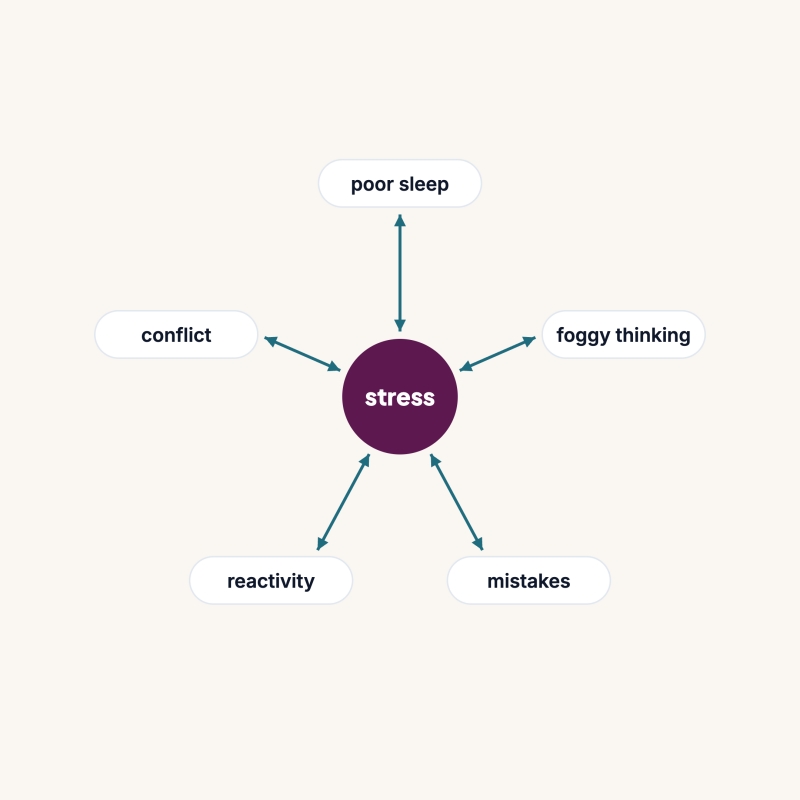
A meeting invite from HR or an all-hands with no agenda is not a predator, but the brain uses the same stress response and prepares you for FFFF (fight, flight, freeze, fawn). There is no one to fight and nowhere to run, so the energy has no outlet, and the body stays in this state long after the trigger has passed. You do not have to be laid off to be affected, because the brain reacts to the threats it perceives. An observational study followed 22 430 employees who kept their jobs through a recession for 7.5 years. Where workplaces cut more than 18% of staff, sick leave and cardiovascular complications were significantly more frequent for those who stayed5.
When a colleague is let go, we grieve the loss of social connections and the version of the team that includes us both. When a round does reach you, you lose the team, the identity, and the version of yourself you built around work. The grief lands on a body that is already strained, and it arrives with new threats: supporting the family, paying the rent, finding a job in an ever-changing market.
Stress and grief reduce memory and concentration, and increase rumination (going over the same thoughts again and again), although they may not share the same mechanisms. When 23 bereaved women were shown reminders of the person they had lost, the brain’s reward circuit (which responds to the things we crave) lit up only in the women with prolonged grief, and the stronger their yearning, the stronger the activation 6. One interpretation is that the brain keeps treating reunion as possible. That fits predictive processing, a hypothesis about how the brain works that I described in Biology of User Friction. Your brain built an internal map and keeps predicting the old situation. The map needs to be rewritten, and that happens slowly, in the background, with time.
The body
Physically, stress and grief overlap: heart rate and blood pressure rise, digestion slows, and sleep and appetite suffer. People describe a pain in their chest, a tight throat, headache, and exhaustion that sleep cannot fix. The main difference is the trigger: stress is anticipation of a threat, while grief begins after a loss. The most important physical players are the sympathetic nervous system and the HPA axis.2
- The sympathetic nervous system speeds up the heart and sends blood to the muscles. The parasympathetic system is meant to bring you back to neutral, though in chronic stress that return is incomplete.
- The HPA axis (hypothalamus, pituitary, adrenal cortex) is slower and delivers cortisol. Cortisol mobilizes energy and dampens immune activity and, over time, makes us more prone to infections 3.
What helps
What helps one person can overwhelm another. I am not a clinician, so I will share what I have learned from research, with a little more weight on the yoga practices, since they are what I have experienced myself and like doing. Because so much of the stress shows up daily, these are best used as prevention, not only as rescue.
The basics
- See a professional. This is a classic. ✨ In a randomized trial of 95 people, a grief-focused therapy outperformed standard interpersonal therapy 7. Part of this therapy is psychoeducation, which means learning what grief is and how it unfolds 1. Medication does not treat the cause, but a clinician might recommend something to help with the symptoms.
- Sleep well. Insomnia is linked to roughly twice the risk of later depression 8.
- Laugh a lot. A meta-analysis of eight small studies found a greater drop in cortisol after laughter than after usual activities 9.
- Move between facing it and not facing it. Healthy grief moves back and forth between facing the loss and engaging with everyday life. Too much avoidance may stall processing, and too much focus may overwhelm 10. Basically, a job-search day and a couch-potato day can exist in the same week.
- Express, but on your terms. Expression helps some people, but it works best when it is voluntary and at your own pace. Rituals like a farewell can ease grief by increasing a sense of control, an effect shown experimentally even for lost lotteries 11.
Breath
Breathing impacts the autonomic nervous system, and it is proposed that this is governed by the locus coeruleus. This is the brain’s main source of noradrenaline, and it also responds to changes in CO2 in the blood. In mouse studies, it has been shown that the rhythm of the breath might impact the release of noradrenaline. 12
Movement
Stress is preparation for exertion, so movement is a response the body anticipates when it signals stress. A meta-analysis of 42 randomized trials found that programs including yoga postures were linked to lower cortisol, blood pressure, and resting heart rate 13.

Mindfulness
Being mindful means turning your attention inward. Meditation is a form of mindfulness that has become extremely popular in tech (with some meetings starting with a short meditation session, which I find very cringe). Reviews find mild evidence that mindfulness improves anxiety, depression, and stress.14 Reviews also showed that roughly 8% of people experienced adverse events (like anxiety, depression, and cognitive issues) even if they had no history of mental health problems. 15. If you have a history of trauma or a serious mental health condition, it is worth talking with a clinician before starting. And a practical piece of advice from me: keep it short and voluntary, and stop if it doesn’t feel right. No, really. Stop.
References & interesting reads
- 1.
Shear, M. K., & Gribbin Bloom, C. (2017). Complicated grief treatment: An evidence-based approach to grief therapy. Journal of Rational-Emotive & Cognitive-Behavior Therapy, 35(1), 6–25.
- 2.
McEwen, B. S. (2007). Physiology and neurobiology of stress and adaptation: Central role of the brain. Physiological Reviews, 87(3), 873–904.
- 3.
Dhabhar, F. S. (2009). Enhancing versus suppressive effects of stress on immune function: Implications for immunoprotection and immunopathology. Neuroimmunomodulation, 16(5), 300–317.
- 4.
Bowlby, J. (1980). Attachment and loss: Vol. 3. Loss: Sadness and depression. Basic Books.
- 5.
Vahtera, J., Kivimäki, M., Pentti, J., Linna, A., Virtanen, M., Virtanen, P., & Ferrie, J. E. (2004). Organisational downsizing, sickness absence, and mortality: 10-town prospective cohort study. BMJ, 328(7439), 555.
- 6.
O’Connor, M.-F., Wellisch, D. K., Stanton, A. L., Eisenberger, N. I., Irwin, M. R., & Lieberman, M. D. (2008). Craving love? Enduring grief activates brain’s reward center. NeuroImage, 42(2), 969–972.
- 7.
Shear, K., Frank, E., Houck, P. R., & Reynolds, C. F., III. (2005). Treatment of complicated grief: A randomized controlled trial. JAMA, 293(21), 2601–2608.
- 8.
Baglioni, C., Battagliese, G., Feige, B., Spiegelhalder, K., Nissen, C., Voderholzer, U., Lombardo, C., & Riemann, D. (2011). Insomnia as a predictor of depression: A meta-analytic evaluation of longitudinal epidemiological studies. Journal of Affective Disorders, 135(1–3), 10–19.
- 9.
Kramer, C. K., & Leitao, C. B. (2023). Laughter as medicine: A systematic review and meta-analysis of interventional studies evaluating the impact of spontaneous laughter on cortisol levels. PLOS ONE, 18(5), e0286260.
- 10.
Stroebe, M., & Schut, H. (1999). The dual process model of coping with bereavement: Rationale and description. Death Studies, 23(3), 197–224.
- 11.
Norton, M. I., & Gino, F. (2014). Rituals alleviate grieving for loved ones, lovers, and lotteries. Journal of Experimental Psychology: General, 143(1), 266–272.
- 12.
Yackle, K., Schwarz, L. A., Kam, K., Sorokin, J. M., Huguenard, J. R., Feldman, J. L., Luo, L., & Krasnow, M. A. (2017). Breathing control center neurons that promote arousal in mice. Science, 355(6332), 1411–1415.
- 13.
Pascoe, M. C., Thompson, D. R., & Ski, C. F. (2017). Yoga, mindfulness-based stress reduction and stress-related physiological measures: A meta-analysis. Psychoneuroendocrinology, 86, 152–168.
- 14.
Goyal, M., Singh, S., Sibinga, E. M. S., et al. (2014). Meditation programs for psychological stress and well-being: A systematic review and meta-analysis. JAMA Internal Medicine, 174(3), 357–368.
- 15.
Farias, M., Maraldi, E., Wallenkampf, K. C., & Lucchetti, G. (2020). Adverse events in meditation practices and meditation-based therapies: A systematic review. Acta Psychiatrica Scandinavica, 142(5), 374–393.